Laser engraver types explained
Quick answer
Buy a diode for wood, leather and dark acrylic on a budget. Buy a CO2 laser for fast cutting, clear acrylic and glass. Buy a fiber laser for bare metal. The deciding factor is wavelength: each material absorbs some wavelengths and reflects others.
This page is the short overview. For the full side-by-side comparison, with a materials table, costs, lifespan and safety, read diode vs CO2 vs fiber laser: which should you buy?
Why wavelength decides what a laser can do
A laser only engraves what absorbs its light. Bare metal reflects most of the light from a 450 nm blue diode and almost all of a CO2 laser's 10,600 nm beam, so the energy never gets into the surface. Metals absorb far more light at around 1,064 nm, which is why fiber and infrared lasers mark them easily. Clear acrylic works the other way round: blue light passes straight through it, while a CO2 beam is absorbed.
The main laser types compared
| Laser type | Wavelength | Bare steel | Wood, leather | Clear acrylic, glass | Typical price (US) | Best for |
|---|---|---|---|---|---|---|
| Blue diode | ~450 nm | Only with marking spray or on coated metal | Yes, excellent | Only with a coating | ~$300 to $2,000 | Wood and dark acrylic; first laser |
| CO2 | 10,600 nm | Only with marking spray | Yes | Yes | ~$500 to $6,000+ | Cutting, clear acrylic, glass, leather |
| Fiber, Q-switched | 1,064 nm | Yes, fast, can go deep | Handles wood poorly | No | ~$1,500 to $4,000 | Tags, tools, tumblers, firearms |
| Fiber, MOPA | 1,064 nm | Yes, plus color marking | Handles wood poorly | No | ~$2,500 to $7,000 | Color marks, black marks on aluminum |
| Infrared diode module | 1,064 nm | Light surface marks | No (paired with a blue diode) | No | ~$500 to $1,500 (portable) | Jewelry, small gifts |
| UV | 355 nm | Light marks | Limited | Yes, very fine | ~$2,500 to $6,000 | Fine detail on plastics and glass |
Price ranges are rough current market ranges for desktop machines, not quotes. Sources: our metal guide and diode guide, which list every source used.
Diode lasers
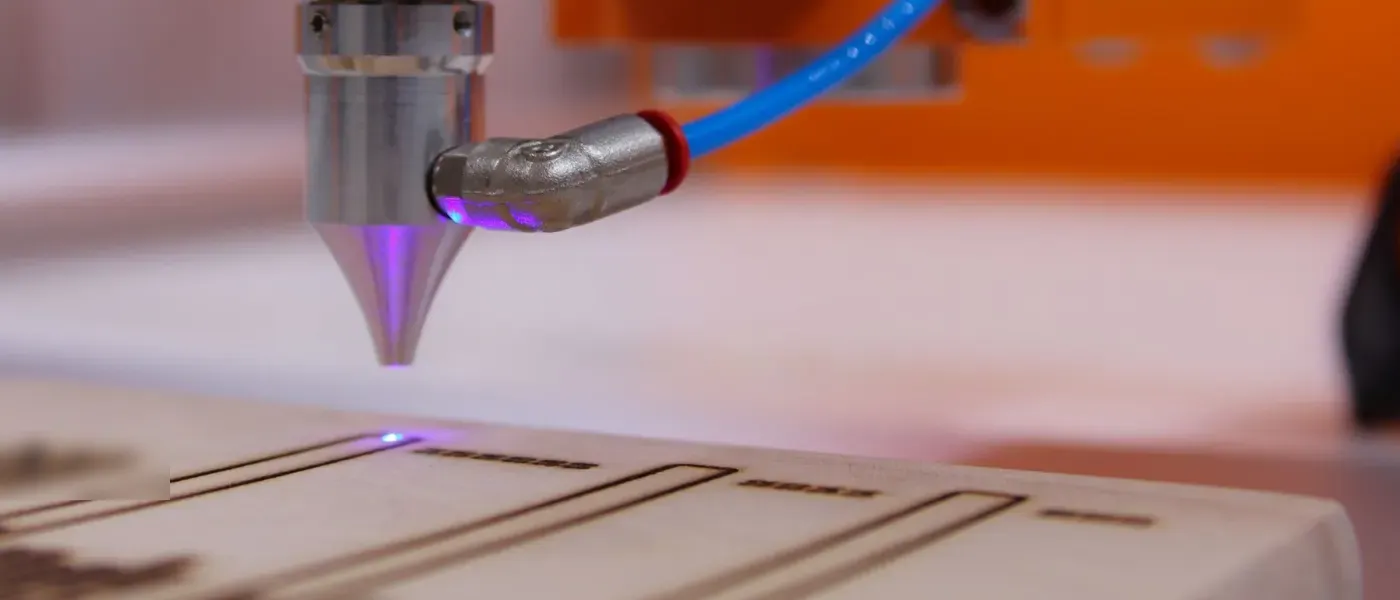
A diode laser makes a blue beam, at about 450 to 455 nm, from a semiconductor module on a moving gantry. It is the cheapest, quietest and simplest type. It engraves and cuts wood, leather, cork, cardboard and dark acrylic, and engraves slate and coated metal. It is slower than CO2 for cutting. Optical power, not electrical power, decides what it can cut; 20 W and up cuts plywood and black acrylic. Just starting out? See the best laser engravers for beginners.
CO2 lasers
A CO2 laser uses a gas-filled glass or metal tube. It cuts faster and thicker, and it handles clear acrylic and glass, which diodes can't. It costs more, takes more space, and needs water cooling and good ventilation. Like a diode, it can't engrave bare metal without a coating or marking spray.
Fiber and MOPA lasers
Fiber lasers work at 1,064 nm and are made for metal. Most desktop fiber lasers are galvo machines: mirrors steer the beam over a fixed marking area, so they mark small items very fast. A MOPA fiber laser adds adjustable pulse length, for color on stainless steel and dark marks on aluminum. Wear glasses rated for 1,064 nm: the beam is invisible.
See the best fiber lasers Best lasers for metal
How to choose
- Start with your main material. Wood and leather: diode or CO2. Clear acrylic or glass: CO2. Bare metal: fiber.
- Then your space. Indoors at home, choose an enclosed machine and plan to vent fumes outside.
- Then your budget, including glasses, ventilation and air assist, which can add $150 to $1,000.
Not sure yet? Try the laser finder or the material checker, or put machines side by side on the comparison page.
Frequently asked questions
Which laser type should a beginner buy?
A diode laser. It is the cheapest, smallest and easiest type, runs from a normal outlet and needs no water cooling. Choose an enclosed model if it will live indoors.
Can a CO2 laser engrave metal?
Not bare metal. Metal reflects almost all of a CO2 laser's 10,600 nm beam. A CO2 laser can mark anodized, painted or coated metal, or bare metal treated with a marking spray.
What is the difference between fiber and MOPA lasers?
Both work at 1,064 nm and engrave bare metal. A MOPA laser lets you change the pulse length, which adds color marking on stainless steel and true black marks on aluminum. It costs more.
Is an infrared diode module the same as a fiber laser?
No. Both work near 1,064 nm, but an infrared diode module is far less powerful. It makes light surface marks on metal and suits jewelry and small gifts, not deep engraving.